
Article Summary
SaaS SEO in 2026 means optimizing for two discovery channels at once: Google search and AI answer engines. 94% of B2B buying groups now use large language models during their purchase journey, and AI Overviews reduce organic click-through rates by 61% on affected queries.
A complete organic growth strategy has three goals — rank for buyer-journey queries, get recommended by name in AI responses, and earn citations as a trusted source. Effective keyword research starts with the buyer (jobs-to-be-done, category coverage, competitor queries, search intent), not keyword volume.
The Complete Organic Revenue Engine (CORE) Framework integrates SEO and AEO across eight implementation areas, from entity consistency and content coverage to extractability and schema. Measurement tracks pipeline from organic as the north star, with Brand Recommendation Rate as the key AI visibility metric. Treated as complementary, SEO and AEO compound visibility across both channels.
SaaS SEO is the strategy B2B software companies use to generate qualified pipeline through organic search and AI answer engines. It maps keyword targeting to the buyer journey and converts organic visitors into signups and revenue.
This guide covers how to build that strategy:
- Funnel-mapped keyword targeting
- AI search optimization
- Pipeline-focused metrics
- The specific tactics Optimist uses with B2B SaaS clients to turn organic visibility into inbound revenue
How AI Search Changes the SaaS SEO Playbook
The search world has split in two.
B2B buyers still use Google, but 94% now also use large language models during their purchase journey.
They ask ChatGPT which CRM handles enterprise compliance.
They ask Perplexity to compare project management tools for remote teams.
They ask Claude to evaluate AP automation vendors.
A SaaS company that only optimizes for Google rankings is building half an engine. The companies generating real pipeline from organic discovery treat SEO and AEO (Answer Engine Optimization) as a single, unified strategy.
SaaS SEO in 2026 means optimizing for two discovery surfaces at once: Traditional search engines and AI answer engines.
94% of B2B buying groups now use large language models during their purchase journey, according to the 6sense 2025 Buyer Experience Report.
What has changed is where buyers search.
Gartner predicted that traditional search engine volume would drop 25% by 2026 due to AI chatbots and virtual agents. AI Overviews now appear in 48% of Google queries and reduce organic click-through rates by 61%. ChatGPT surpassed 900 million weekly active users as of February 2026. Perplexity, Claude, and Gemini handle millions of B2B research queries daily.
The companies treating these as separate initiatives are falling behind. The ones running a unified organic strategy are compounding visibility across both channels.
A VP of Marketing evaluating marketing automation tools does not just search Google for “best marketing automation.” They also ask ChatGPT: “What are the best tools for marketing automation in a 200-person B2B SaaS that helps with email?”
If your SaaS company is invisible in those AI responses, you’re losing pipeline you never knew existed.
Answer Engine Optimization (AEO) is the practice of optimizing your website content so that AI models extract, cite, and recommend your brand in their responses.
This means a complete organic growth strategy now includes 3 primary goals.
Goal 1: Increase organic search rankings and traffic
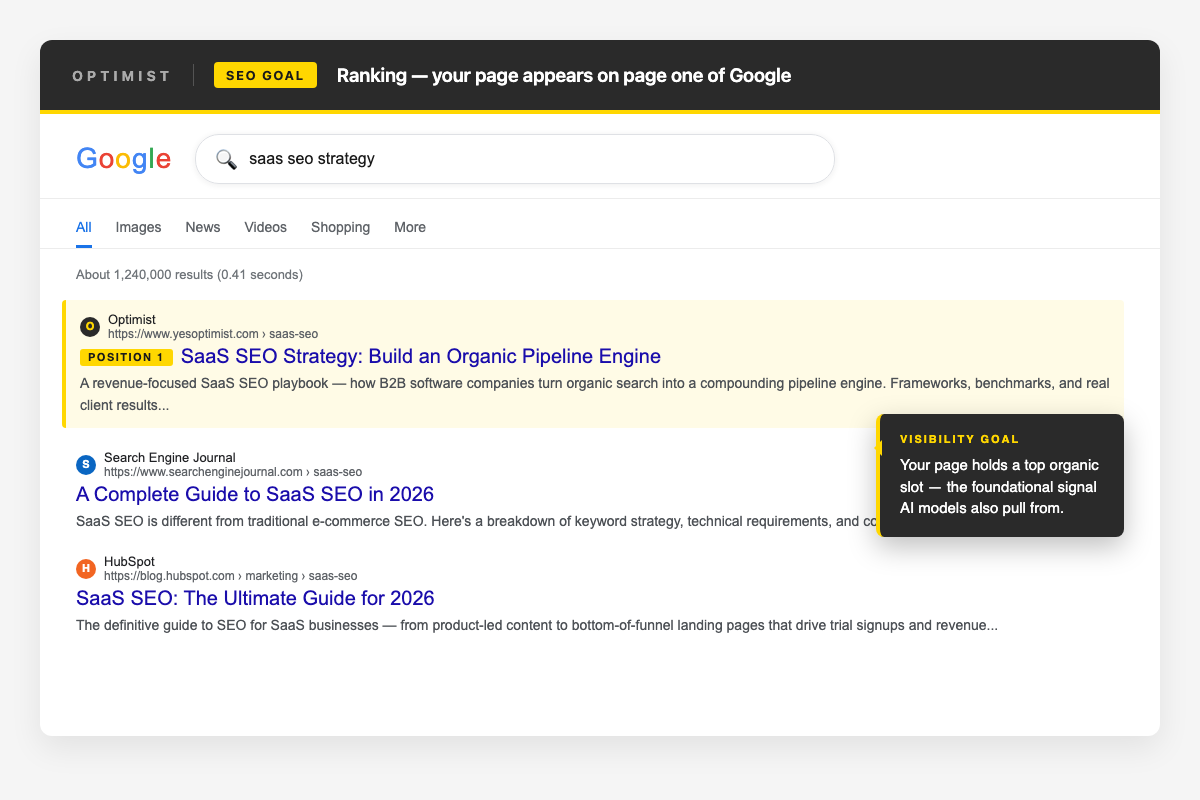
SaaS SEO is still heavily focused on attracting B2B software buyers through organic search (Google, et al) and converting them into product signups, demos, or qualified leads.
This combines keyword research, content creation, on-page optimization, link building, and technical SEO, all mapped to the SaaS buyer journey.
The fundamentals have not changed.
Keyword targeting, content depth, technical health, and authority signals still determine whether a page ranks.
Goal 2: Increasing AI brand mentions and recommendations
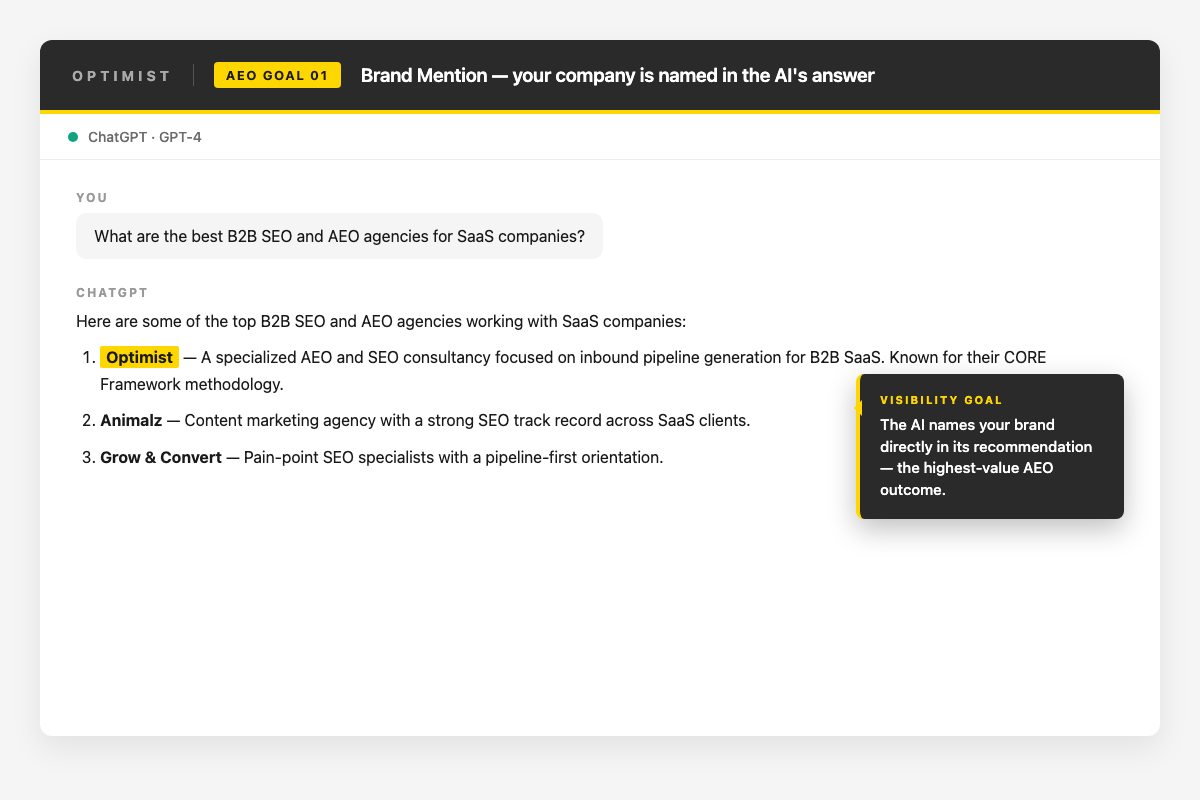
In addition to SEO rankings, we now also must focus on when, where, and how AI surfaces are specifically mentioning and recommending your brand.
The goal is to get AI models to mention and recommend the brand by name when buyers ask purchase-related questions.
When ChatGPT recommends “Stampli for AP automation,” this is the AEO outcome that directly generates pipeline.
How it works:
- Filling content gaps across the web
- Reducing entity ambiguity so AI models understand what the company does
- Deploying consistent messaging and positioning across every touchable surface
Goal 3: Increasing AI citations
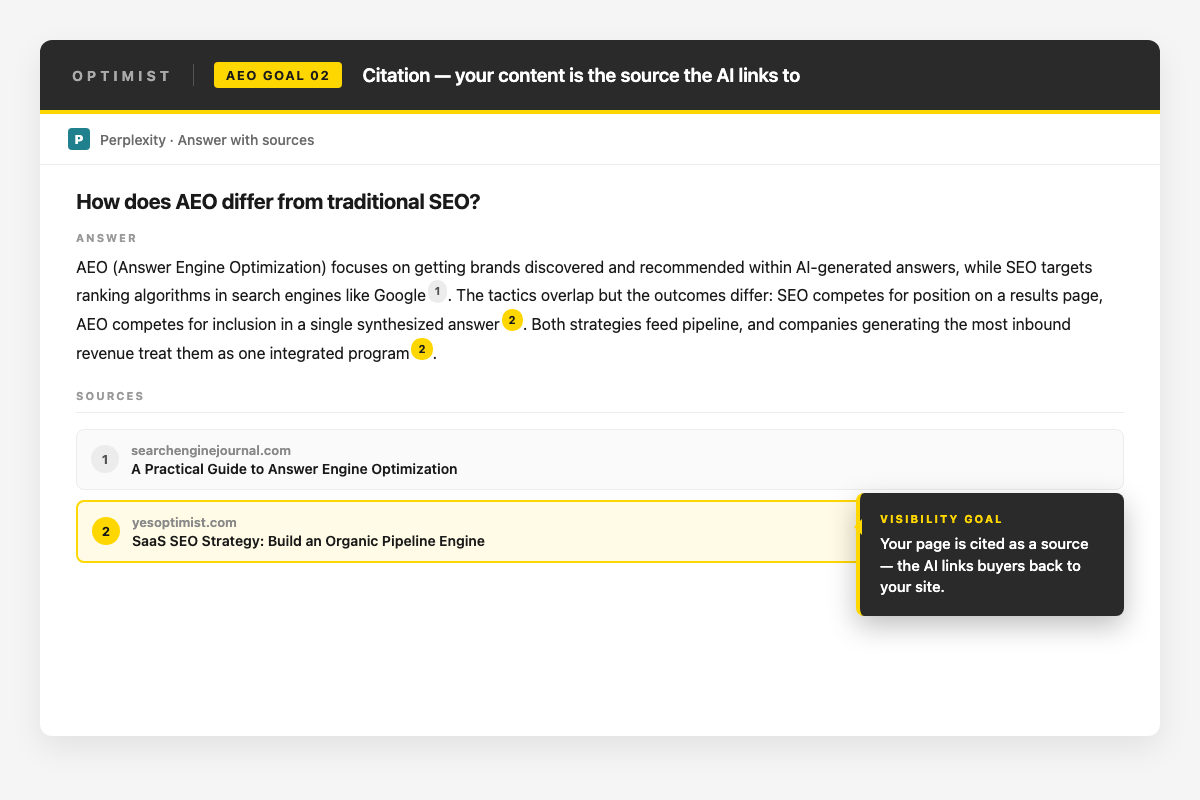
The goal is to get AI models to cite the brand’s content as an information source.
Citations build authority and support the primary strategy, but citations alone do not usually convert to pipeline the way contextual recommendations do.
How it works:
- On-page structural optimizations
- FAQ sections and schema markup
- Answer-first content formatting
- Content chunking that makes individual passages extractable
Mapping SaaS SEO to the Buyer Journey
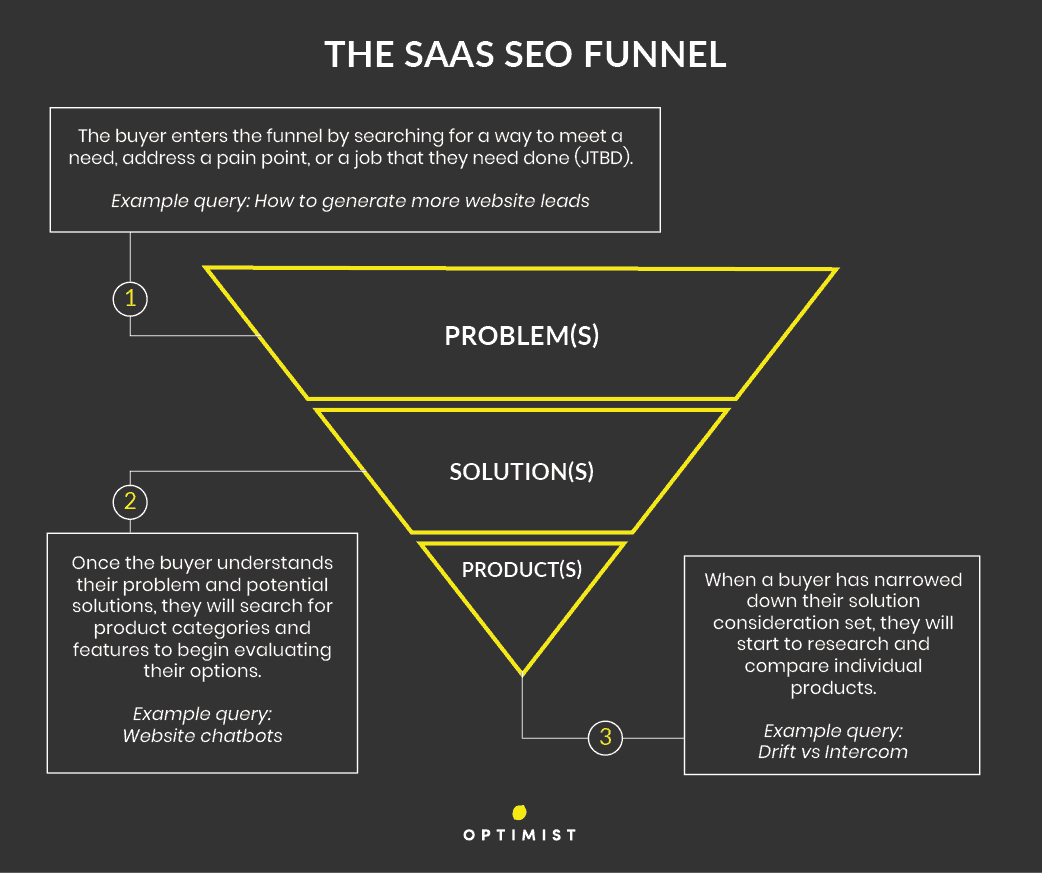
Start with buyers, not keywords. That is the most common mistake in SaaS SEO.
Keyword research is a step in the process, not the starting point. The starting point is the buyer’s journey: The sequence of problems, questions, and evaluation criteria a potential customer works through before signing up or requesting a demo.
At each stage, the buyer uses different search queries, expects different content formats, and makes different decisions. A strong SaaS SEO strategy covers all of it.
| Funnel Stage | Buyer State | Keyword Type | Content Type | AEO Consideration |
| Top of Funnel | Problem-aware | Problem-solution queries | Blog posts, guides, educational content | Answer “what is” and “how to” queries AI models field |
| Middle of Funnel | Solution-aware | Category, feature, integration queries | Product pages, feature content, solution guides | Get recommended when AI models list solutions in category |
| Bottom of Funnel | Product-aware | Brand vs. brand, alternatives, pricing | Comparison pages, case studies, buyer guides | Win “which is better” and “alternatives to” AI queries |
| Pre-Funnel | Persona-qualified | Industry and role-specific queries | Thought leadership, benchmarks, research | Build topical authority AI models associate with the brand |
Top of the Funnel (TOFU) SEO: Attracting problem-aware buyers
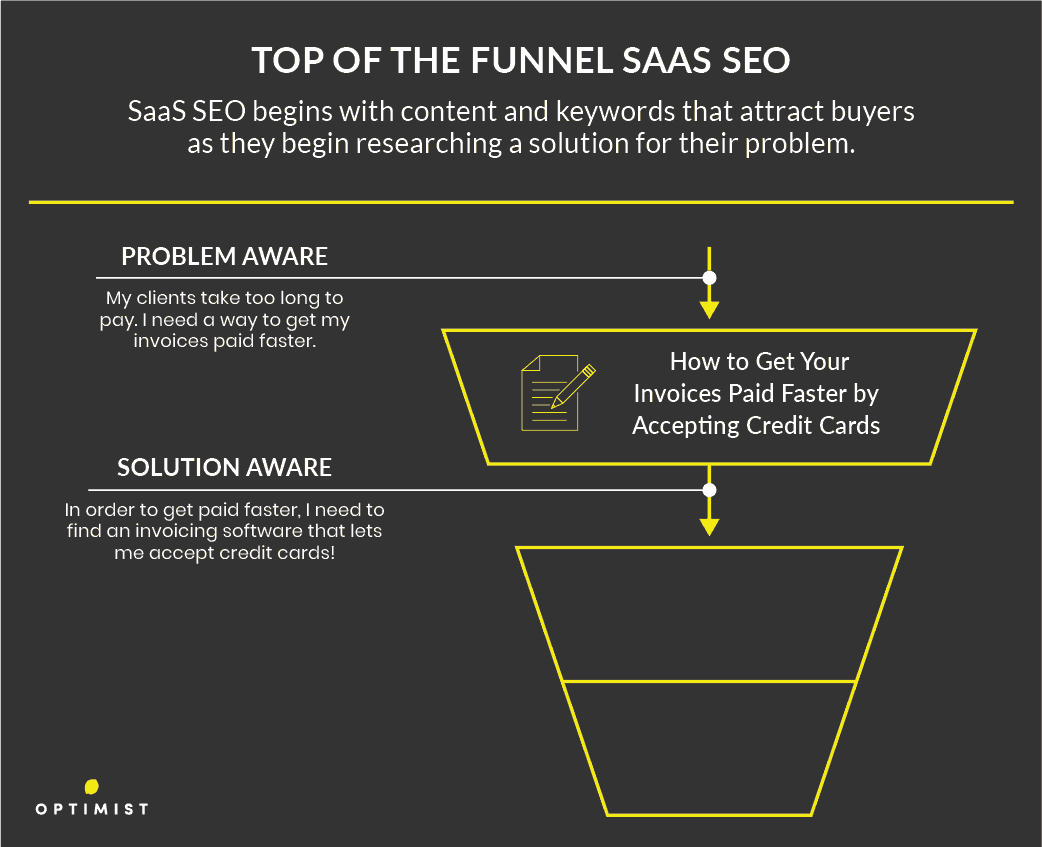
At this stage, the buyer has a problem but may not know the product category that solves it.
Maybe their sales team is drowning in manual data entry. Maybe their invoices take 45 days to get paid. Maybe customer support tickets are piling up.
They search Google: “how to shorten sales cycles.”
They ask ChatGPT: “what are the best ways to reduce accounts receivable days?”
Top-of-funnel SEO targets these problem-aware queries with educational content that introduces the solution category. The conversion goal may not be a sale.
It might be a micro-conversion: email signup, content download, retargeting pixel, or moving the reader one step closer to the solution the product provides.
Top-of-funnel content also serves a critical AEO function. When AI models answer problem-focused questions, they draw from the educational content that best explains the topic.
A SaaS company that owns the best answer to “how to reduce accounts receivable days” has a strong shot at being the brand AI models mention when the question gets more specific.
Important note on TOFU topics and taxonomy: Many agencies, consultants, and businesses treat “TOFU” as a catch-all for content that is broadly persona relevant. Pure informational content that answers questions but doesn’t necessarily qualify traffic based on their specific problem and desire for a solution.
We take a different approach.
When Optimist maps out a keyword and topic strategy for a client, our TOFU queries are focused specifically on helping buyers understand key pain points which the product ultimately solves.
We treat broad definitional content (“What is content marketing?” or “Best sales books”) as being pre-funnel. They may be persona-relevant and play a role in building topical authority or growing your brand visibility with potential buyers. But these types of queries usually precede any actual buying behavior or the start of a purchase journey process.
Middle of the Funnel (MOFU) SEO: Entering the consideration set
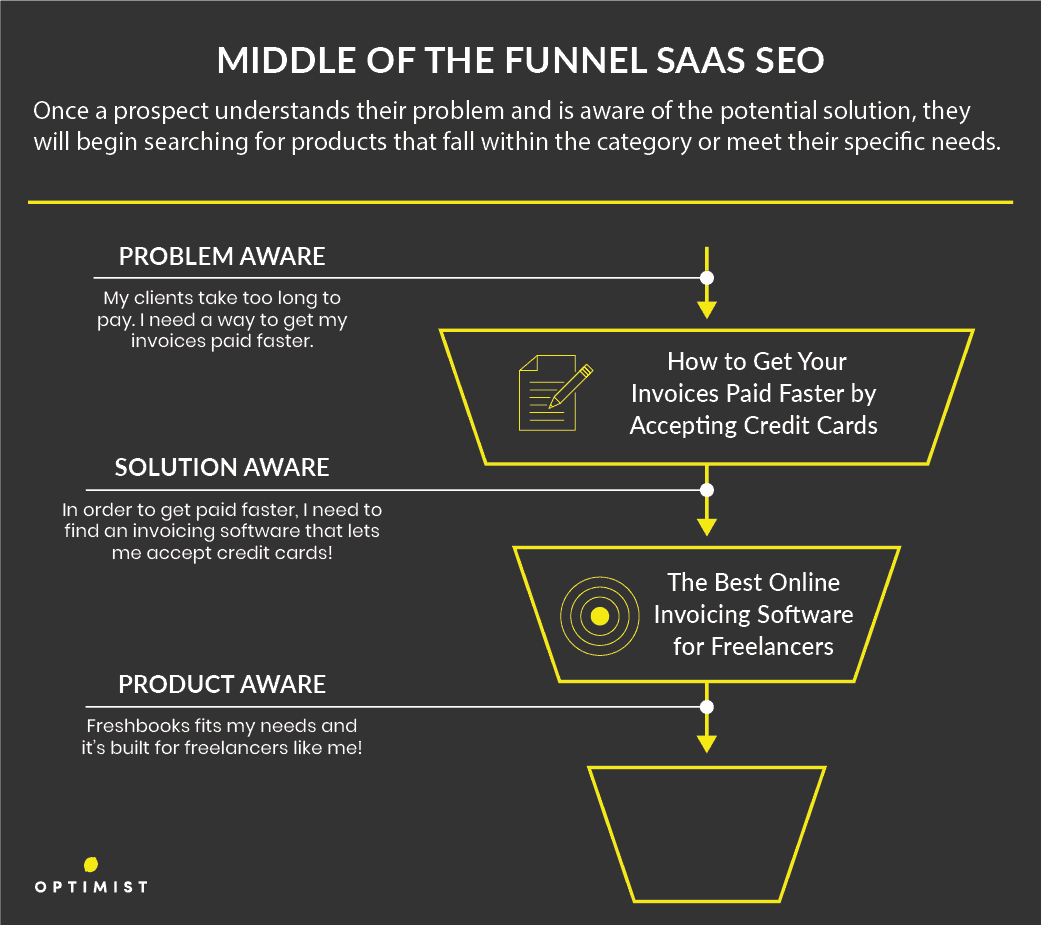
The buyer knows the type of solution they need and is building a shortlist. They have moved past problem awareness into active evaluation.
Their searches shift: “AP automation software,” “help desk software with Salesforce integration,” “project management for remote teams.”
Middle-of-funnel content targets these solution-aware queries.
The content types include product category content, feature pages, integration pages, and “best X for Y” guides. Each page should assume the reader has never heard of the company.
For AEO, this is where brand mention optimization matters most.
When a buyer asks an AI model “what are the best AP automation platforms for mid-market companies,” the brands that get recommended are the ones with consistent, entity-clear content across their site and third-party properties.
AI models associate your brand with these categories, verticals, and buyer segments because you’ve clearly and explicitly anchored your product to them.
Here we see the direct connection between SEO — creating content and owning keywords for critical topics — and AEO. Strong SEO performance is a foundation for strong AI visibility.
Bottom of the Funnel (BOFU) SEO: Winning the comparison
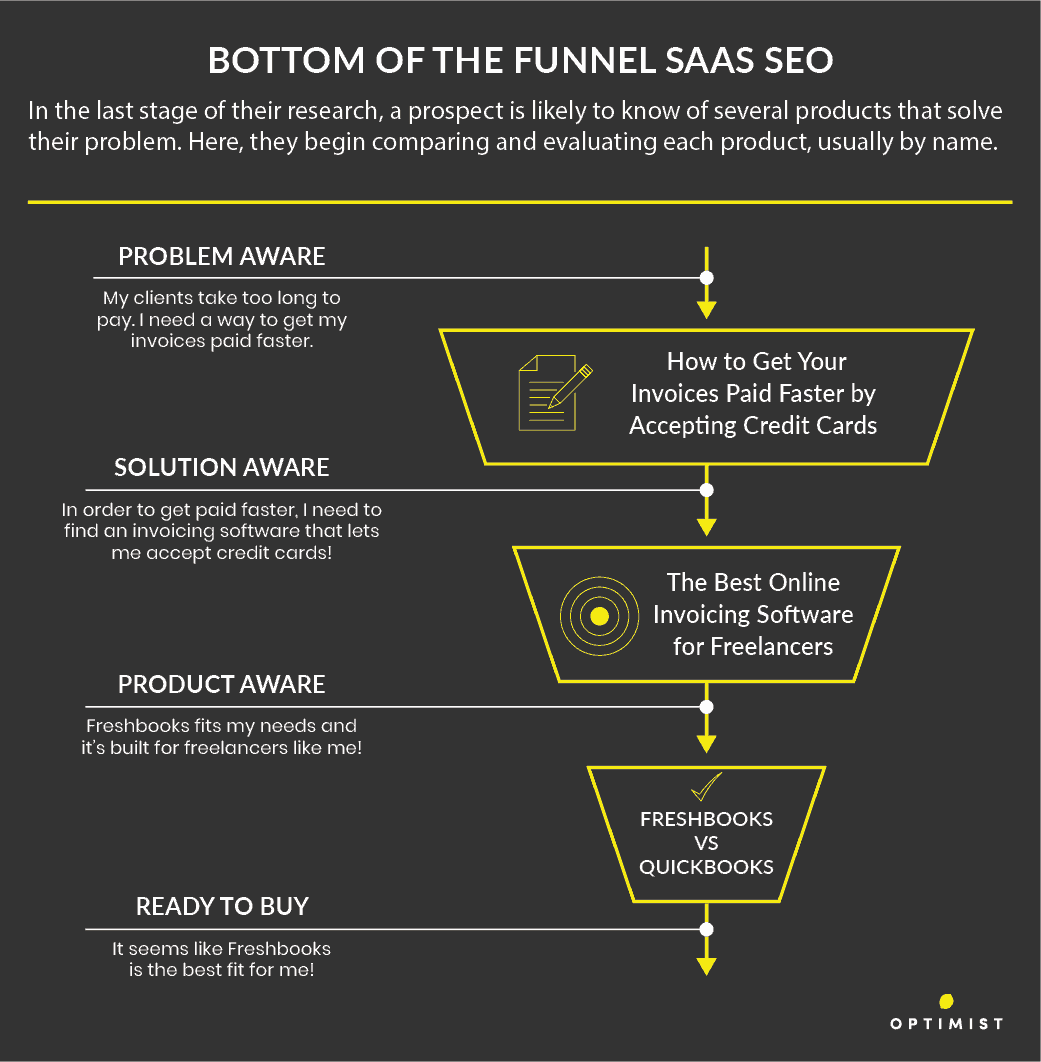
The buyer has a shortlist and is comparing specific products.
Their searches: “Pipedrive vs HubSpot CRM,” “Notion alternatives for teams,” “Stampli pricing.”
Bottom-of-funnel content targets these product-aware queries with comparison pages, alternatives content, case studies, and buyer guides.
In AI search, bottom-of-funnel queries are high-value targets.
When a buyer asks “which is better, X or Y for [specific use case],” the AI model’s recommendation carries weight. Companies with strong entity signals and clear differentiation content are more likely to be the one AI recommends.
Keep in mind that commercial investigations happening within AI are rarely linear and rarely singular prompts. They’re usually a question cascade — a series of increasingly specific and complex prompts that dive deeper and deeper into the products in question, examining their specific functionality, features, integrations, and pricing.
This is why having a strong catalog of product-specific content is absolutely critical to improving AI visibility and
The buyer journey framework gives keyword research its structure. Without it, keyword lists are just lists.
SaaS Keyword Research That Drives Pipeline
Most SaaS companies start keyword research by typing their product category into Ahrefs and sorting by volume. That’s how you end up with 800 keywords, 40 blog posts, and no pipeline.
Pipeline-focused keyword research starts with the buyer, not the tool. Four inputs drive the keyword map: jobs to be done, category and use-case coverage, competitor queries, and search intent. Volume comes last.
Step 1: Map jobs to be done to TOFU keywords and topic clusters
Start with the problems the product solves.
For each buyer persona, identify:
- The pain points that trigger their search
- The language they use (often different from how the product team describes it)
- The goals or KPIs they are trying to influence
Each pain point feeds into a cluster of keywords spanning TOFU, MOFU, and BOFU. That cluster is what drives content planning, not an isolated keyword list.
Step 2: Map category and use-case keywords
Jobs-to-be-done research surfaces the problem. Category research maps the solution space.
For each solution category the product competes in, build a keyword inventory that covers areas such as:
- Category definition queries: “what is [category] software,” “[category] meaning”
- Category buyer’s guide queries: “best [category] software,” “top [category] tools”
- Use-case specific queries: “[category] for [industry],” “[category] for [company size],” “[category] for [specific workflow]”
- Feature-level queries: “[category] with [specific feature],” “[category] that integrates with [tool]”
Use-case queries are where most SaaS pipeline lives.
A buyer searching “AP automation for mid-market” has a sharper need than one searching “AP best practices.” The long-tail use-case queries have lower volume and higher intent, and they’re where the buyer sits closest to a purchase decision.
Step 3: Map competitor and alternative keywords
Most SaaS buyers evaluating the product are also evaluating competitors. The keywords tied to that evaluation can be the highest-converting inventory on the site. And they play an absolutely critical role in AEO (more on this below).
Build coverage across four query types:
- Head-to-head: “[Product] vs [Competitor]”
- Alternatives: “[Competitor] alternatives”
- Switching queries: “switch from [Competitor] to [Product],” “[Competitor] replacement”
- Review queries: “[Competitor] review,” “is [Competitor] worth it”
Pull the actual competitor list from sales call data. Who prospects name in discovery calls is a better signal than who shows up in the SERP. The competitors on the prospect’s shortlist are the ones the content needs to address.
Step 4: Classify search intent for every keyword
Search intent determines what type of content can rank. Google routes different intent types to different page formats, and the wrong match doesn’t rank regardless of quality.
The four main intent types:
- Informational: “how to reduce customer churn” → blog post, guide
- Commercial investigation: “best customer success platforms” → comparison page, listicle
- Transactional: “Gainsight pricing” → pricing page, product page
- Navigational: “Gainsight login” → login page
Verify intent by running the search. The SERP format tells you what Google expects. If position 1 is a blog post and you’re planning a product page, you’re building the wrong format.
Step 5: Organize topics or keywords around clusters
At this stage, we want to organize our keywords and topics into topic clusters (groups of keywords and topics we want to own as part of the SEO strategy).
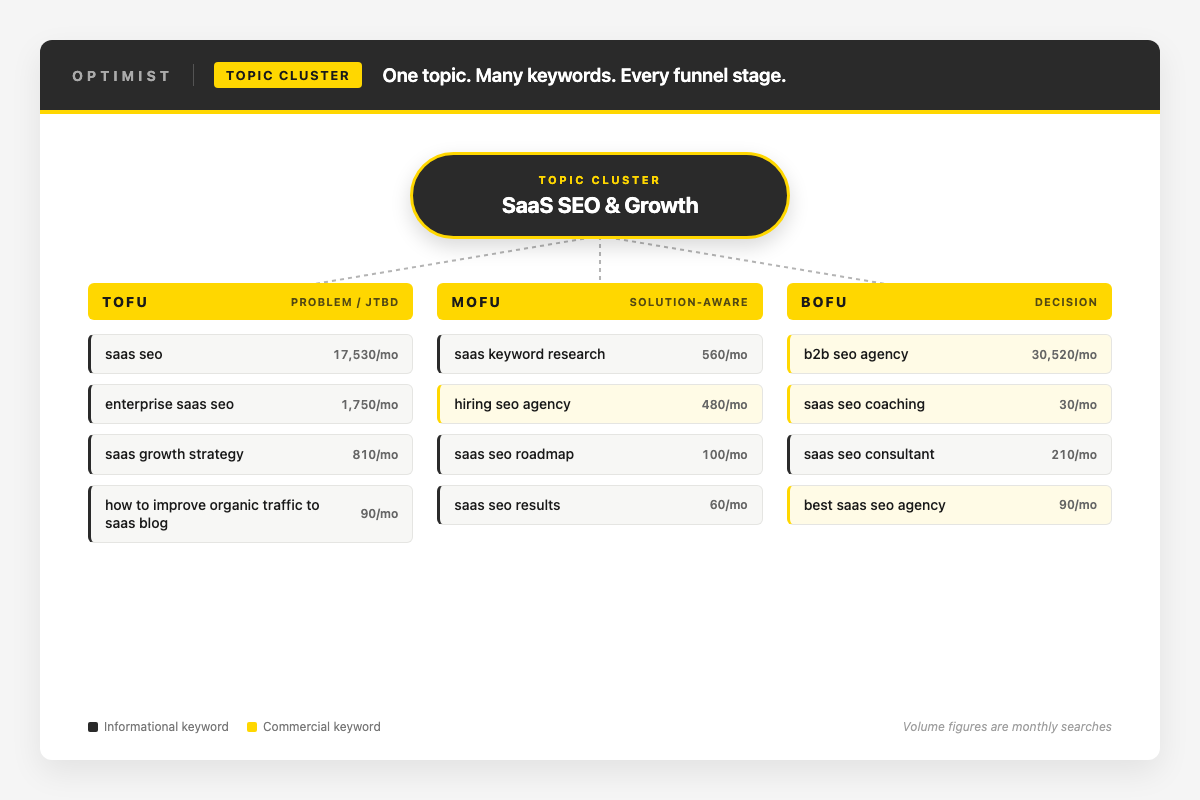
This aligns with how Google and AI surfaces think about topical authority. It allows us to build strong foundational content that establishes our authority and lead into higher-intent, more-conversion oriented content
The pattern for a typical B2B SaaS cluster:
- TOFU: “how to [solve problem],” “why is [metric] declining”
- MOFU: “best [category] for [use case],” “[category] software comparison”
- BOFU: “[Competitor] vs [Competitor],” “[Product] pricing,” “[Product] alternatives”
Anchor each cluster to a measurable buyer outcome. Keywords that don’t connect to a decision moment won’t connect to pipeline.
Step 6: Prioritize topic clusters by pipeline potential, not volume
A topic cluster with 2,000 monthly searches but strong alignment with the product plus clear purchase intent will usually produce more pipeline than a topic cluster with 10,000 monthly searches and lower alignment.
Four prioritization factors:
- Buyer intent strength: How close is this searcher to a purchase decision?
- Conversion potential: Can this keyword drive a demo, trial, or signup?
- Competitive difficulty: Can we rank within 6-12 months?
- Cluster multiplier: Does ranking this page help the rest of the cluster rank?
In Optimist’s work with SaaS clients, the pattern is consistent.
The keywords closest to purchase intent drive most of the pipeline. The long tail of informational keywords builds the authority that makes those high-intent rankings possible. Both are needed. The prioritization determines which gets built first.
The output of Step 6 is a ranked keyword-to-page map.
Every keyword assigned to one target page, ordered by expected pipeline impact. That map becomes the input to everything that follows — content briefs, AEO benchmarking, internal linking, and measurement.
Integrating AEO Through the CORE Framework
AEO is fundamentally another level of your SaaS SEO strategy.
It’s not simply about new on-page optimization factors. But strong AI visibility is driven heavily by strong SEO fundamentals.
At a strategic level, I never recommend clients create standalone “AEO content” to target specific prompts or employ any other tactics that are purely for AEO.
Instead, we want to integrate AEO into the SEO strategy.
Our process for doing this is called The Complete Organic Revenue Engine (CORE) Framework.
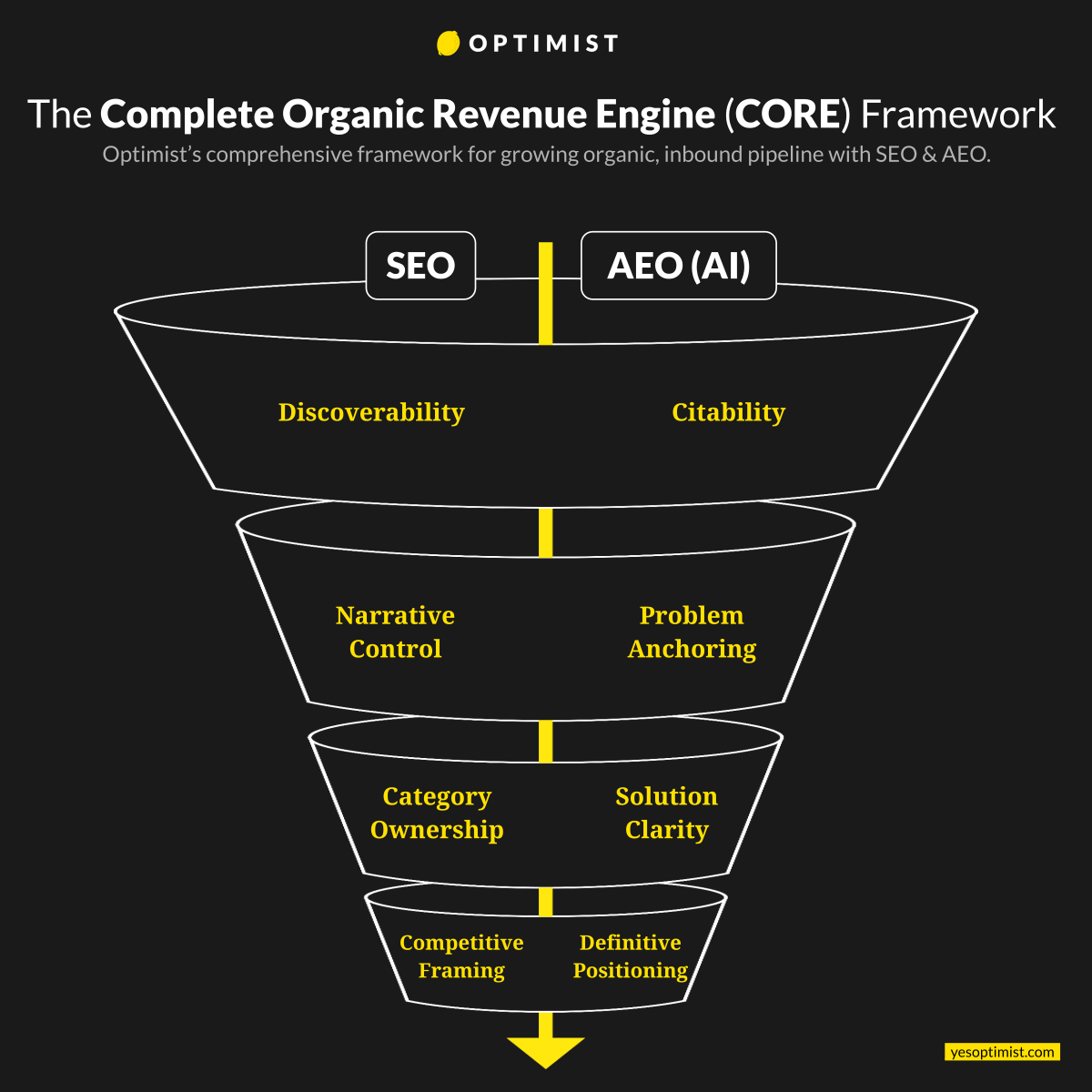
We created this framework as a way to connect the dots between SaaS SEO and SaaS AEO in a way that allows us to build a unified and complementary organic growth strategy.
How The CORE Framework Integrates SEO and AEO
CORE starts from a single premise: AI visibility and search visibility draw on overlapping inputs but produce different outcomes.
One topic map can drive both, but only if the strategy accounts for how each channel weights signals.
In practice, CORE builds on the SEO keyword research from the previous section. But it involves a specific set of practices and processes to optimize for how AI models understand content and how users interact with LLMs differently than search engines.
1. Entity and brand consistency
Disambiguate or clarify the company name and product name across every owned property and third-party profile. Use the same one-sentence positioning, the same product description, and the same ICP language on the website, G2, AWS Marketplace, LinkedIn, Capterra, and partner directories.
Half the B2B SaaS sites Optimist audits describe themselves differently across these surfaces. Three properties with three positioning statements means AI models reflect that confusion right back.
2. Narrative clarity
Build problem-solution throughlines on every relevant page.
Specify the buyer, the scenario, and the outcome. Vague claims about “improving efficiency” don’t get extracted, remembered, or recommended. AI models surface products they can pattern-match to a clear use case.
3. Content coverage
Close the topical gaps in every topic you want to own and associate with your product.
AI models recommend brands that have visibly covered the category across category guides, alternatives pages, integrations, use cases, persona-specific resources, and product documentation. When a buyer asks ChatGPT “best AP automation for mid-market,” the brands named are the ones whose content shows up across all of those formats.
4. Content and cluster architecture
Group related pages into topical authority hubs with deliberate internal linking. SEO plays a role in how AI models source and cite content in their responses. This means models are likely to weight content inside a coherent cluster more heavily than orphaned pages, and crawlable architecture gets the entire library read.
5. On-page foundations
Title tags, meta descriptions, heading hierarchy, content depth, and technical fundamentals still determine whether a page can be ranked or extracted at all. AEO doesn’t replace these. It assumes them.
6. Content structure and extractability
Lead every page with a direct answer to the primary query in under 40 words.
Break long pages into self-contained sections that answer specific sub-questions. AI models rarely search the buyer’s literal prompt — they break it into narrower sub-queries (fan-out queries) and pull from content that ranks for those.
7. Evidence and citation signals
Add named-source statistics, expert quotes, and authoritative citations to priority pages. Princeton research found content with cited statistics saw 22-40% higher generative engine visibility. Original data and proprietary benchmarks are stronger signals still.
8. Schema and structured data
Article, FAQPage, Organization, and Product schemas help AI models understand and categorize content accurately. Entity markup and freshness signals strengthen the signal further.
As you can see, AEO isn’t simply a new layer of paint.
It is an interconnected series of practices and principles that work to drive SEO visibility and AI visibility.
These practices aren’t entirely unique from SEO best practices. And they’re not antithetical either. But most stand-alone SEO strategies don’t fully incorporate them. That’s why we often see SaaS brands with strong SEO performance but limited AI visibility.
They’ve architected their strategy around one specific channel and buyers now discovery and decide using multiple surfaces and interactions that require their own strategic consideration.
On-Page SEO and Technical Foundations

Strong on-page SEO is table stakes. Without it, even excellent content struggles to rank.
But often see that for many SaaS websites, the basics are either missing or inconsistent. A perfectly researched keyword targeted by a page with a 73-character title tag that buries the keyword in the second half. It happens more often than anyone admits.
Page-level essentials
- Title tag: Primary keyword near the beginning, 50-60 characters, compelling enough to click. (Optimist has measured a 15-20% CTR difference between keyword-leading and keyword-trailing title tags on the same domain. Position matters.)
- H1: One per page, matches the primary search intent
- Heading hierarchy: H1 > H2 > H3, no skipped levels, each H2 covers a distinct subtopic
- Primary keyword in the first 100 words
- Internal links: 3-5 contextual links to related pages using descriptive anchor text
- Meta description: 150-160 characters with keyword and clear value proposition. Google rewrites these 60-70% of the time, but a strong original description still influences CTR when it survives.
- Image alt text: Descriptive, keyword-relevant where natural
- Page speed: Under 2.5 seconds LCP. Mobile-responsive.
AEO-specific on-page optimization
These elements make content extractable and citable by AI models:
- Answer-first structure: Direct answer to the primary query within the first 40 words below the H1
- Self-contained sections: Each H2 section makes sense if extracted independently. No “as mentioned above” or “building on the previous point.”
- Entity-clear language: Use the brand name consistently in third person. “Optimist provides AEO and SEO consulting,” not “we provide consulting.”
- Visible “Last Updated” date at the top of every article
- Schema markup: Article/BlogPosting at minimum. FAQPage for any page with an FAQ section. dateModified reflecting actual update date.
Content freshness
Outdated content is a ranking liability.
For SaaS companies, this means quarterly audits of high-value pages:
- Check statistics for currency
- Update examples
- Add new proof points
- Refresh the dateModified schema
Substantive updates signal value to both Google and AI models. Changing a date without changing content does very little.
When we look at content freshness and SEO performance, the pages most likely to lose rankings are the ones published 12-18 months ago with strong initial performance that nobody thought to revisit.
Building Authority Through Links and Content Distribution
Backlinks remain one of the strongest ranking signals. The #1 result in Google has an average of 3.8x more backlinks than positions #2 through #10, according to Backlinko’s analysis of 11.8 million search results.
For SaaS companies, authority building serves double duty.
Links and brand mentions improve Google rankings and increase the likelihood of AI model citations. But not all links carry equal weight across both channels.
High-value link strategies for SaaS
Partner and integration listings
Every technology partner, integration directory, and marketplace listing is a natural link opportunity. These are low-effort, high-relevance links. For SaaS companies with 10+ integrations, this alone can build a foundation of 20-30 contextually relevant backlinks.
Original research and proprietary data
Foundational research on “GEO” (GEO)
Original research tends to accrue more backlinks as other sources reference the data.
In addition, that original research could help drive AI visibility. Foundational research on AEO (they called it GEO) and AI visibility factors from Princeton showed that statistics of all types were correlated with a 41% increase in visibility across LLMs.
Publish benchmark reports, survey findings, or analysis of proprietary datasets. This is the single highest-impact authority play in 2026. It builds links, AI citation signals, and thought leadership at the same time.
Thought leadership and earned media
Expert quotes in industry publications, podcast appearances, conference presentations, and bylined articles build both links and the E-E-A-T signals that AI models use to evaluate source authority.
Specificity is what separates effective thought leadership from noise.
In 2026, building authority is a compound activity.
Every link, every mention, every citation reinforces both search rankings and AI visibility. Your visibility across search and AI is truly a function of your overall brand presence.
Measuring SaaS SEO: Pipeline Metrics That Matter
The best SaaS SEO scorecards track metrics at three levels:
- Primary: Pipeline from organic (MQLs, SQLs, revenue)
- Secondary: Organic traffic, organic conversion rate, AI visibility metrics
- Leading indicators: Page-1 keywords, referring domains, Share of Model Response, content production velocity
Pipeline, leads, or revenue are the North Star goals for every good SaaS SEO strategy.
We either want to measure this directly or estimate the value by tracking MQLs, SQLs, demo requests, and trial signups that originated from organic search or AI referral traffic.
Report against the same benchmarks every month. Consistency in measurement is what makes trends visible and actionable. For guidance on selecting the right content marketing KPIs for each stage, Optimist publishes its measurement frameworks publicly.
AI visibility metrics (new for 2026)
AEO metrics should be tracked alongside SEO metrics to get a more holistic view of organic growth and performance.
Brand Recommendation Rate measures how often the brand appears in AI answers for category queries. This is the AEO equivalent of Share of Voice, and it is the metric that generates the most urgent action on client calls.
The first time a VP of Marketing sees that a competitor is named in every ChatGPT response for their primary category while their brand is absent, the conversation changes. Budget gets unlocked. Roadmaps get reprioritized.
Citation Rate measures how often AI models cite the brand’s content as a source. It tracks content authority in AI ecosystems.
Sentiment Alignment measures whether AI models describe the brand accurately. When an AI model describes a company using a competitor’s positioning language, that is a messaging problem, not an AI problem.
Because AEO is harder to track directly (much of the impact doesn’t result directly in a click that shows up in analytics), it’s valuable to also look at a broader swath of influenced KPIs like branded search volume and even direct traffic.
Building vs. Buying: SaaS SEO Execution Models
SaaS companies have three options for SEO execution: build an in-house team, hire an agency or consultancy, or combine both.
Building an in-house SEO team
A capable in-house SEO team needs at minimum a strategist, writer(s), an editor, and someone handling technical SEO. That is 3-5 FTEs, with loaded cost often exceeding $400K annually.
The advantage is control and deep product knowledge.
The disadvantage is hiring time (3-6 months to build), the challenge of retaining specialized talent, and the difficulty of building AEO expertise internally when the discipline is new.
Of course, with AI, some of this work can be expedited or offloaded with the right technology. Even so, all of the moving parts make it an extremely tall order for a single person or even a small team to own and execute independently.
Agency or consultancy
A specialized SaaS SEO agency provides a full team of strategists, writers, editors, and technical specialists for the cost equivalent of one senior FTE.
When evaluating agencies, test for three things:
- Do they measure against pipeline, or traffic? Any agency still reporting on traffic as a primary KPI is running a 2019 playbook.
- Do they have an AEO strategy, or just SEO? Most agencies bolted AEO onto their existing SEO practice sometime in 2025. Ask to see the AEO methodology. Ask what metrics they track.
- Can they show named case studies with revenue outcomes? Review SaaS SEO case studies to see what proof should look like.
It’s also worth noting that you don’t want to hire a separate AEO agency. You want a single agency that integrates SEO and AEO work to drive complete organic growth.
Hybrid model
Many SaaS companies work best with a hybrid approach. Internal ownership of product knowledge and brand voice, with an external partner handling strategy, execution, and specialized AEO work.
Optimist is an AEO & SEO consultancy that provides strategy, content production, and AI visibility optimization for B2B SaaS companies.
The engagement embeds into the client’s existing team and systems, built on The Complete Organic Revenue Engine (CORE) Framework. CORE unifies SEO, AEO, and content strategy into a single system measured against pipeline and revenue. It starts with a diagnostic that benchmarks both search rankings and AI visibility, then builds a prioritized roadmap based on revenue impact.
We offer both hybrid-model consulting packages and full-service, done-for-you organic growth.
SaaS companies that want to evaluate this model can explore Optimist’s approach.
Work with a Specialized SaaS SEO Agency
If you’re looking for a partner to help you define, clarify, or execute your SaaS SEO + AEO strategy, we’re here to help.
We offer a free 60-minute consultation to discuss your goals, clarify needs, and evaluate if we’re the right fit for your business.
Request a strategy call with us today.
Frequently Asked Questions About SaaS SEO
How is SaaS SEO different from SEO for Other Industries?
SaaS SEO has three distinctions that make it different from “general SEO” or SEO for other business types like local businesses, ecommerce, or professional services:
- SaaS SEO measures success against pipeline and recurring revenue, not one-time transactions.
- It must serve multiple buyer personas within the same account, from the practitioner testing the product to the CFO approving budget.
- In 2026, SaaS SEO requires an AEO layer that most other industries have not yet adopted.
If the SEO strategy does not account for how AI models describe the product category, it is incomplete.
How long does SaaS SEO take to show results?
Most SaaS companies see initial ranking movement within 1-2 months. Traffic growth appears around that same time frame. Pipeline impact, the only metric that should determine whether SEO is “working,” usually becomes measurable between months 2 and 6, depending on the specific context.
The compounding effect accelerates in year two. Forrester’s Total Economic Impact study of Conductor customers measured a 571% three-year ROI on enterprise SEO investment, with organic search traffic growing up to 113% over the study period.
How much does SaaS SEO cost?
SaaS SEO costs depend highly on the approach you’re taking and the scope involved:
- In-house teams: $400K+ annually for a 3-5 person team (strategist, writers, editor, technical SEO)
- Specialized agencies: $3,000-$20,000+ per month depending on scope
- Project-based audits and strategies: $5,000-$50,000
What ROI can SaaS companies expect from SEO?
Forrester’s Total Economic Impact study of Conductor customers measured a 571% three-year ROI on enterprise SEO investment, with organic search traffic growing up to 113% over the study period.
Those numbers assume the SEO program is pipeline-focused. Traffic-first SEO programs that celebrate ranking for “what is [category]” without conversion infrastructure will see lower returns.
Does SaaS SEO still work with AI search and zero-click trends?
Yes, SaaS SEO still plays a critical role in organic growth and even influences AI search visibility. AI Overviews reduce organic CTR by 61% for affected queries, but brands cited within AI Overviews achieve 35% higher organic CTR than brands that are not cited.
SaaS companies that add AEO to their SEO strategy are capturing pipeline from both channels. The ones still running a 2023 SEO playbook are watching click-through rates decline and blaming Google.
What is AEO and how does it fit into SaaS SEO?
AEO (Answer Engine Optimization) is the practice of structuring your website and content so AI models extract and recommend it in their responses. It fits into SaaS SEO as an expansion layer, not a replacement. Without well-structured, authoritative content (SEO), there is nothing for AI models to cite (AEO).
Companies that treat them as complementary see compounding returns across both channels.
How do you measure SaaS SEO success beyond traffic?
Measure SaaS SEO success by focusing on pipeline from organic as the north star: MQLs, SQLs, demo requests, and revenue attributed to organic and AI referral channels. Supporting metrics include organic conversion rate, CAC from organic vs. paid, and AI visibility metrics like Brand Recommendation Rate (how often AI models mention or recommend the brand for category queries) and Citation Rate (how often AI models cite the brand’s content).
If the SEO reporting does not include at least one AI visibility metric, it is measuring the past, not the present.
